Proposed as Chapter 7 in:
Oliver Scheiding (University of Mainz) and Jan Stievermann (Heidelberg University), eds.,
A "Peculiar Mixture":
German-Speaking People in the Greater Mid-Atlantic Region from 1709 to the Revolution, (under contract with Pennsylvania State University Press)
The emergence of cultural history as an influential mode for understanding the past provides still untapped opportunity for early American Pennsylvania German specialists to position themselves and their subjects in a broader interpretive context. This methodological development can enrich our understanding of the creation of creole societies in the New World by encouraging us to conceptualize German-speaking people in North America as central to its thoroughgoing multicultural diversity. Pennsylvania Germans plainly articulated an "ethnic" sensibility of remarkable durability, and this dynamic cultural expression changed over time and drew upon varied resources that were local and transatlantic as well as material and spiritual. The traditional focus of early American historical analysis has tended to emphasize politics, war, the state, and law that all implicitly (and often explicitly) made Anglo-American subjects their near exclusive terrain of inquiry. Subsequent interpretive departures like social history and literary studies have broadened our purview, but those methods' respective quantitative and textual commitments have often led its practitioners to treat early American German speakers as isolated, atypical, or exceptional.
Cultural history as practiced here aspires not to be a linear "improvement" on these past and ongoing methods of scholarly inquiry, but to synthesize the insights in preceding work and to address some of its shortcomings. From more traditional methodologies cultural history shares a commitment to what happens in public and thus was broadly shared and recognized throughout society, and in common with more recent research priorities it seeks to reach beyond the foremost leaders in the past to assess a fuller range of human experience, endeavor, and self-understanding. Keeping cultural analysis at the center of our interpretive endeavor may yet yield a wholly new awareness of major forces shaping long term historical development in North America and requires that we examine both our deep continuities with and profound divergences from early American practices in our ongoing engagement with cultural diversity. How does understanding the place of German-speakers in dominantly English-speaking Revolutionary America help us to understand that period as well as our present in new ways? 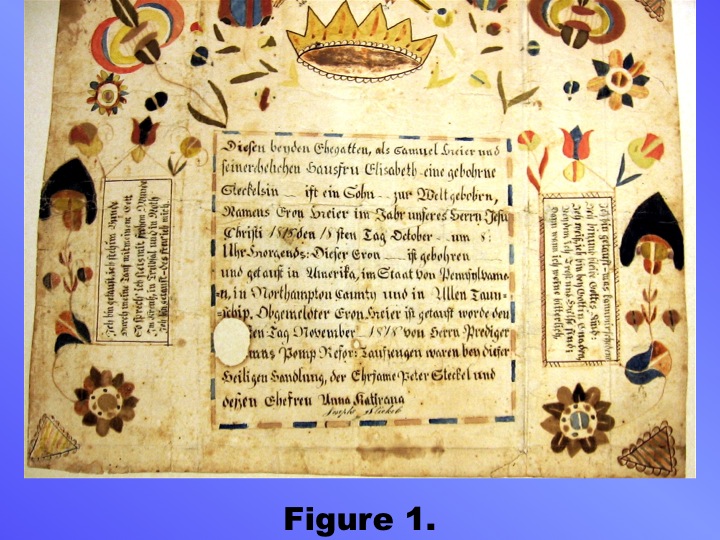 This essay responds to that question by analyzing taufscheine, distinctive pictorial and textual work on paper that celebrates the birth and baptism of a child by recording key personal information in words on a document decorated with colorful images; indeed, the letters in this tradition are themselves decorative and thus contribute importantly to the visual power of the genre. A taufschein by an anonymous artist recording the birth and baptism of Eron Meier in 1818 provides a useful starting point for assessing this powerful form of Pennsylvania German expression (figure 1). Although the artist is unknown, this hand drawn certificate hews to the bright color palette of the genre and copies widely used symbolic and textual elements popularized by some of the best known and most prolific taufschein producers of the period. For example, the bright yellow crown with red stripes at its top center, as well as the striped triangles in its bottom corners, are immediately recognizable as akin to the work of Friederich Krebs, who will be discussed further below. Similarly, the floral rosettes in each corner and the large stylized flowers at the top resemble Martin Brechall's work. While the Meier taufschein may be a bit basic (with more open space and a more simple layout than often occurs), it was clearly crafted with care, used fraktur lettering throughout (except for the bottom signature of Joseph Stiekel), and drew upon a fluent understanding of the standard textual and iconographic norms of the genre.
This kind of "Pennsylvania Dutch" folk art is highly sought by collectors and has been the subject of considerable stylistic, artistic, and genealogical analysis, yet there are surprisingly few assessments of this strikingly effective means of preserving and expressing individual and ethno-religious identity by historians. Building from the estimate that 80 percent of all surviving handcrafted Pennsylvania German material culture was produced from 1770 to 1840, this essay argues that during the broad Revolutionary period members of this cultural group acted with greater vigor and self-consciousness to claim a more public space for themselves in the post-colonial nation. Pennsylvania Germans deployed taufscheine to reflect their newly assertive sense of ethnic particularity and, just as importantly, used them to engage non-German cultural forms and technical developments in an innovative and effective manner. Taufscheine were not fading expressions of isolated folk traditions soon to pass, but a bold hybrid form that took advantage of mechanical reproduction and numerous Anglo-American visual elements that helped the form to remain vital into the twentieth century even while remaining immediately recognizable as non-English. Just as the increasing use of printed taufscheine and an inclusive iconographic range demonstrates powerful Pennsylvania German interaction with other cultural groups and social practices, this essay shifts in its closing pages from the close analysis of specific examples to consider the wide geographic distribution of one itinerant artist's work and asserts the importance of making mixed pictorial-textual evidence more central to our understanding of the past. The methods and interpretive priorities of cultural history are especially well suited to examine taufscheine and to explore how Pennsylvania Germans used them to make a clear and lasting mark on the public landscape of the long Revolutionary period. Related to this argument about treating Pennsylvania Germans as central to early American society and culture is also a substantial methodological claim that cultural history can be most effective when it not only recovers stories about specific cultural artifacts but also considers their social roles as larger sets beyond the single individual item.
The public launch in fall 2009 of the extraordinary Fraktur Digital Collection, an online database created and hosted by the Free Library of Philadelphia, marks a turning point in our ability to interpret this material. This database permits a sophisticated assessment of over 1,000 examples of Pennsylvania German work on paper created before 1845. Not only are high quality images available online, the website also provides a full transcription and translation of all text on these items and permits keyword searching within eleven data fields, including personal names, place of creation, stylistic elements, and dates. The analysis that follows builds upon and expands my previous study of Pennsylvania Germans in the town of Easton, the seat of Northampton County, Pennsylvania. More than sixty fraktur artists are known to have been active in this area prior to 1850, and an assessment of work from this area permits a broader perspective on a large terrain of the human landscape in the Revolutionary Era. As was the case across the large swath of Pennsylvania German settlement that arced around Philadelphia from northern New Jersey, slanting across the interior of Pennsylvania, on into Maryland, and then to the Virginia and Carolina backcountry, almost all the German-speakers considered here were "church Germans" (kirchenleute), that is, Lutheran and German Reformed congregants, who typically shared a common "union church" (gemeinschaftliche Kirchen) building. Unlike the various "sect Germans," whose wartime persecution Jan Stievermann thoughtfully assesses in his essay in this volume, the much more numerous church Germans studied here used Revolutionary mobilization and American independence to demand a more central place for themselves in the new United States.
The First United Church of Christ in Easton, Pennsylvania, the direct descendent of the colonial era German Reformed congregation in the town, continues to worship in the union church building raised in the 1770s that it shared for nearly six decades with local Lutherans. Today it prominently displays four eighteenth-century objects that provide a compelling introduction to the rich material expression of early Pennsylvania Germans. A display case to the right of the altar holds three pewter pieces: a chalice made by the Rhineland-born William Will, who immigrated to New York City as a boy in 1752 and worked there and in Philadelphia; a German-made flagon from the first half of the eighteenth century by an unidentified artisan; and a tankard with the stamp of Gregory Ash and William Hutton, whose Bristol, England, partnership was active from 1741 to 1768. These three church pieces, and especially the graceful chalice by Will, highlight the sophistication of Pennsylvania church Germans as well as the varied geographic and cultural connections that these objects in motion brought to this institution.
The central item in the display cabinet, however, is even more immediately impressive. A large Bible had been given to the congregation by the Swiss-born Michael Schlatter, a missionary sent by the Synod of Holland to aid struggling German Reformed congregations in the middle colonies in the late 1740s. The two-page frontispiece of the Basel-printed Bible was later distinctively decorated by Johannes Ernst Spangenberg, Easton's schoolteacher, scrivener, and an active fraktur artist, in the 1770s. His handwritten text in the Bible combines German (in mostly black fraktur letters) and Latin (in red cursive script), he filled its borders with colorful stylized birds, flowers, and a portly trumpeter, all in characteristic Pennsylvania German style. Just like the church pewter that now stands alongside it, this Bible highlights the cosmopolitan ties of people in a small frontier town of the late-eighteenth century to multiple European countries and languages.
Yet taufscheine might seem to be different sorts of objects than the communally-owned vessels and Bible with their formal religious and public roles. Were the carefully crafted birth-and-baptismal certificates more private and personal? Were they talismans of a peculiar people who felt alienated from the dominant Anglo norms of their society? At first glance, this view seems plausible, and the connotations of "folk art" have often encouraged that they be treated as naïve, provincial, and parochial forms. The broken-letter fraktur script suggests a strong tie to continental forms that along with the consistent (though not exclusive) use of German seems to make these powerful expressions of central European traditions. While there are important continental precursors for taufscheine that we continue to learn more about as transatlantic scholarship grows, most specialists have agreed that these are a distinctive New World form rather than a continuous practice carried across the Atlantic and maintained in colonial settings. As Frederick S. Weiser remarked in 1973, while there is a "very clear lineage in Europe," "Pennsylvania Taufschein represent a clear departure from Old World prototypes." Much like ethnic awareness itself, with which taufscheine and fraktur, more broadly, are so intricately intertwined, migration and household and community formation in wholly new circumstances encouraged a novel cultural expression of hybrid self-understanding that drew on past practices in dynamic and unanticipated ways.
Fundamental to appreciating the vibrant novelty of the taufschein form is the recognition of its intensive focus on the specific individual information about a person's date of birth, place of birth, and parentage. While the familiar term for the genre emphasizes baptism as its key element, the fuller term geburts-und taufschein is more accurate, since it is the birth information, above all, that is most essential. These colorful papers document a key moment in life that is simultaneously about spirituality, domesticity, and generational transition, but, above all, they met a pressing need to record basic information about individual identity in a fluid New World context that lacked the ordering structures of established church, robust government with meaningful coercive power, legally sanctioned social privileges, and long term intergenerational ties to place that defined most European societies in the eighteenth century. As Don Yoder has noted, American taufscheine directly filled the void left by a lack of official birth records with legal seals (geburtsbrief) that had been issued by churches as government institutions in central Europe. Even more than the spiritual importance of recording baptism, godparents' names, the name of the minister performing the rite, all of which are often missing from completed taufscheine, or even the recurrence of an increasingly standardized small handful of scriptural and devotional passages about baptism, the central meaning of the form and its long term popularity that far outpaced other kinds of fraktur work arose from the basic need it met to document birth and family identity. That the form was also widely used by members of German sect groups that did not practice infant baptism further underscores the primacy of taufscheine as records of birth information and domestic ties. The careful documentation of a child's identity sets American taufscheine most apart from its varied central European antecedents.
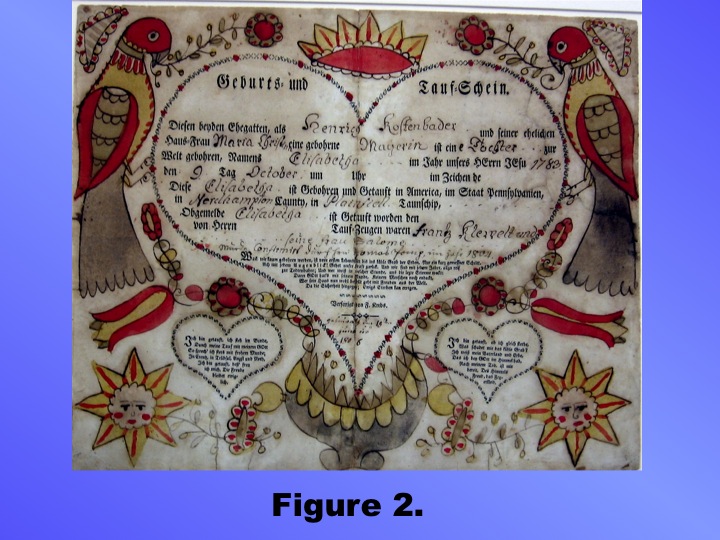 The anonymous artist who produced the Meier taufschein (figure 1) borrowed directly from the visual repertoire of other prolific artists, most notably Martin Brechall (c. 1757-1831) and Friederich Krebs (1749? - 1815?). This close relationship is especially evident in the certificate that Krebs made for Elisabetha Kostenbader (figure 2). One's eye is immediately drawn to the prominent crown that appears at the top center of both images. Also striking on the Kostenbader taufschein, and immediately recognizable as the work of Krebs, are the large cofrontal "parrots" (the Carolina parakeet, actually, then quite familiar in the Mid-Atlantic) that were likely first used to influential effect by the artist Henrich Otto, who will be discussed further below. The producers of these objects clearly shared similar social and communication networks and regularly sampled one another's work.
Like so many taufschein makers, Krebs was an immigrant, and the fraktur work that he sold, along with hatboxes made from cardboard and wallpaper, helped to supplement his income as a schoolteacher in Dauphin County, Pennsylvania. His known certificates reveal that he was an active craftsman from 1784 to 1812, and he created an enormous number of images—perhaps more than any other single artist—and traveled intensively across the cultural region with known examples for children born in seven Pennsylvania counties as well as in Hunterdon County, New Jersey. Perhaps most revealing of all, however, is that several different producers created the Kostenbader taufschein. Krebs did the freehand artwork and colored its borders. The general three-heart form upon which he worked and its black fraktur text was printed by a newspaper letterpress, while the blank spaces within the text of the large heart were filled in with personal information about Kostenbader by two different people (one of them, perhaps, Krebs) who both wrote in loose script letters (i.e., non-fraktur, unlike the handwork in figure 1). This handwritten text was not impressive calligraphy and seems unlikely to have been the work of professional scriveners.
What was professional, indeed forcefully commercial, was the printed form upon which Krebs colored and others inserted details about Elisabetha Kostenbader's early life. This widely used three-heart form was made on a mass scale to reach consumers across a region much larger than the face-to-face community of even a far-traveling taufschein peddler. Krebs cannot have had close personal familiarity with his far-flung consumers, but he enjoyed success across hundreds of miles because his work resonated with the values and visual sensibilities of people across a large area of Pennsylvania German culture. As he moved across this space seeking customers, Krebs made sure that his authorship was announced on the printed form. "Verfertigt von F. Krebs" (Prepared by [or done by] F. Krebs) is printed in medium-sized font at the bottom of the large central heart and is set off graphically by horizontal lines of symbols above and below this printed "signature." Starting in 1790 Krebs relied on a German newspaper press in Reading, Pennsylvania (some sixty miles from where he lived), to print his three-heart forms, and his art has been identified on twenty printed variants of this form. More extraordinarily yet, because the account books of the Adler newspaper survive, we know that Krebs purchased 6,974 printed taufschein forms between 1801 and 1813, and in 1804 alone, his peak purchasing year, he acquired 1,987 forms in three large acquisitions. Even though this craftsman supplied his own paper, and was charged just 53 cents for every one hundred forms, he paid his debt in installments and still owed the printer $2.67 when he died in 1815. Krebs was certainly a folk artist, but he worked on a geographic, technical, and commercial scale that belies the provincial and isolated rural connotations of folk art. That only 155 examples of Krebs' massive output survive, he could have produced over 7,000 items, for he worked in at least four styles in addition to the three-heart form, challenges us to scrutinize and assess this widespread form with care and precision.
Given the enormous production scale of the undecorated "three-heart" printed form favored by Krebs, and used by many other artists as well, it is worthwhile to review the basic organization and format of this particularly influential and early mass-produced German-language form. The uppermost text in the Kostenbader example plainly announces that this is a birth and baptismal certificate (Geburts-und Tauf-Schein), parents' names follow with the husband, of course, coming first, as reflects patrilineal norms, but an important space is reserved here to also identify the maiden name of the wife. Not only does this provide linguistic and visual evidence outside English norms, it also preserves a genealogical understanding probably connected to partible inheritance practices with a stronger commitment to preserve matrilineal awareness than in the English tradition. The married mother's prior family name almost always appears on taufscheine. The form continues by leaving space for date and place of birth as well as the time of day and the astrological sign in which the child was born. While it is clear that English- and German-language almanacs in early America both paid careful attention to astrology, including this information on a birth certificate seems a notable departure from Anglo-American practice. The large printed font in the top two-thirds of the main heart ends with spaces left open to add the date of baptism, the sponsors, and the name of the officiating minister.
Below this primary area for entering important personal information related to the child, three blocks of text in smaller font provide devotional passages, first in the lower register of the large heart, then in the two smaller hearts to the lower left and right. The spiritual messages here are the three most frequently repeated passages on taufscheine and remind the reader, that is, if one choose to scrutinize these crowded parts of the document, that death is fundamental to the human condition and thus one should celebrate the inestimable treasure of baptism. As the text in the bottom left heart announces: "I am baptized, I stand united with my God through my baptism. I therefore always speak joyfully in hardship, sadness, fear and need. I am baptized, that's a joy for me. The joy lasts eternally." This and the other two passages reprinted on this form are taken from Johann Friedrich Starck's wildly popular devotional book, which was first published in Germany in 1727, attained its heavily-used Pennsylvania German form in 1731, and was only first translated in the U.S. by an 1855 Philadelphia imprint. As Don Yoder notes, Starck's book "had a phenomenal circulation in Europe and was undoubtedly the leading prayer book used in private devotions among the Pennsylvania Germans." The combination of personal information and devotional text is itself fascinating, and it becomes all the more compelling when we recall that this taufschein was simultaneously a commercial product.
If taufscheine were close to ubiquitous in printed, handmade, and mixed forms throughout the Pennsylvania German region, what did they mean to the people for whom they were made? This is, of course, the essential question, but its answer remains elusive. A closer look at the information entered by hand on Elisabetha Kostenbader's certificate and placing it in the context of other examples moves us toward a more intimate, though still partial, understanding of what taufscheine may have meant for their recipients. After the names of her parents, her birth in Plainfield Township, Northampton County, on October 9, 1783, and the names of her baptismal sponsors, the spaces for date of baptism and officiating minister were left empty. Consequently, it seems unlikely that this form was made close to the time of her birth and baptism, yet since her confirmation by Easton's Reformed minister Thomas Pomp in 1804 is added as a final freehand entry, squeezed into the extra space above the first printed devotional text, it seems likely that she and her family belonged to the Reformed congregation in that town, which abuts Plainfield. The final handwritten information here, in a different hand from the rest, records Elisabetha's marriage on June 15, 1806, to an unnamed person.
There are two main departures here from the information requested by the printed form. First, the exclusion of astrological and complete baptismal information. Second, the addition of confirmation and marriage data. But both of these discrepancies appear frequently in other examples of the genre. Although taufscheine preserve a sparse trajectory of a life course, they primarily serve as biographical statements about individual development to the point of household independence—always stressing birth, usually including baptismal information, often adding confirmation and marriage data, but very rarely mentioning death. There is no substantial evidence to suggest how these paper forms were preserved and viewed in the domestic context of their recipients' lives, but it seems unlikely that they were treated as decorative objects to be hung on walls. In place of being able to assess the lived context in which taufscheine were experienced, the close scrutiny of surviving examples is our most promising interpretive course.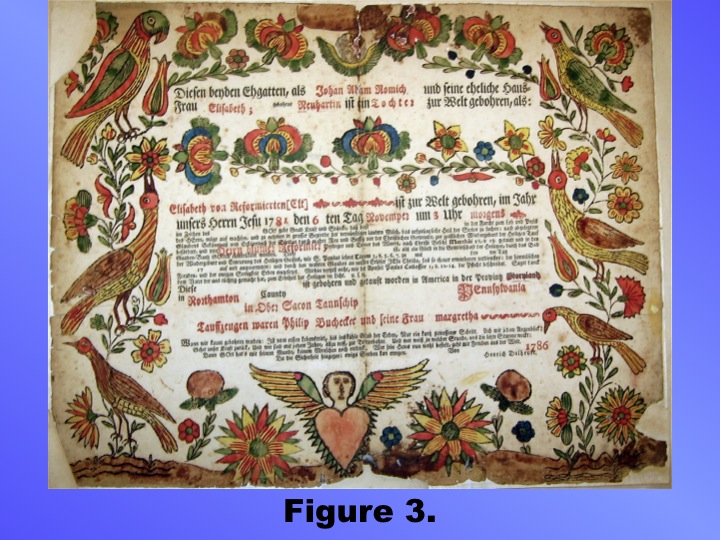 Because the mass-produced work of Krebs challenges many frequent assumptions about folk art, generally, and Pennsylvania German traditions, in particular, it is revealing to turn to an earlier example from 1786 to demonstrate that even at an initial phase of its popularity, taufscheine makers worked across a large geographic terrain and made sophisticated use of mechanical reproduction. This large, dramatic example for Elizabeth Romich (figure 3) is the product of three different makers. The form was printed at the Ephrata Cloister, near Lancaster, Pennsylvania, for Henrich Dulheuer (? - c. 1816), as indicated by his printed name on the bottom right of the form. Dulheuer had deep religious commitments that inspired him to travel widely in Pennsylvania, Kentucky, the Carolinas, and, as this printed form makes clear, he made Baltimore and Washington County, Maryland, his base of activities for a period. In this example, the scrivener has had to delete Maryland from the printed form and replace it with Pennsylvania, for Elizabeth was born in Upper Saucon Township, Northampton County. Having the form printed was probably Dulheuer's sole contribution to this example, and, though only active as a taufschein publisher and distributor from 1780 to 1786, he was a major figure. As Richard and Corinne Earnest note, he "may properly be called the earliest of the major itinerant scriveners. No free-hand certificates made by him are known." His influence as a distributor of printed forms arises particularly from his close, though somewhat elusive relationship with the master colorist and artist (Johann) Henrich Otto, whose likely contribution to this example we shall turn to shortly.
What is perhaps most remarkable about the Romich taufschein, however, is the role played by Freidrich Deubler (active c. 1786), who is only known by seven surviving examples, four from Northampton County and three from adjacent Berks County. Deubler added the personal information on this form in distinctive red ink and printed, rather than hand inscribed, the names of specific people, dates, and places involved. As early as 1786 we have both a printed form on which was printed specific individual information by a second contributor. Finally, the elaborate birds and flowers on the left and right sides were added later from woodblocks and then colored, while the winged angel at bottom seems hand drawn, and the child's (or angel's) face at the top seems to have been printed with the text and then hand colored.
This decoration was probably done by (Johann) Henrich Otto (1733? - c. 1799), who, like Dulheuer, pioneered the use of printed forms from the sabbatarian commune at Ephrata, but worked almost exclusively as a non-textual artist and colorist. A 1785 form printed by this press for Otto with his printed signature is quite similar to figure 3 and includes the identical bird and flower woodblock prints on either side with slightly variant coloring done by hand. Russell and Corinne Earnest, who have carried out the most systematic evaluation of taufscheine, claim that Otto "influenced American fraktur art probably more than any other single person," thus it is "one of the biggest disappointments" in the field that we know so little about him. What is certain, however, is that by the 1780s printed forms had been in regular use by some craftspeople for at least a decade, and that the production of taufscheine involved many people from printers and distributors to visual and textual artists. On the consumption side there were, again, many people involved, frequently as many as six named people on each document in spaces designated for parents, child, godparents, and minister. Finally, the geographic reach of these early printed forms is impressive—here, a quintessentially "Pennsylvania" German form had been produced on a large scale intended for use in Maryland.
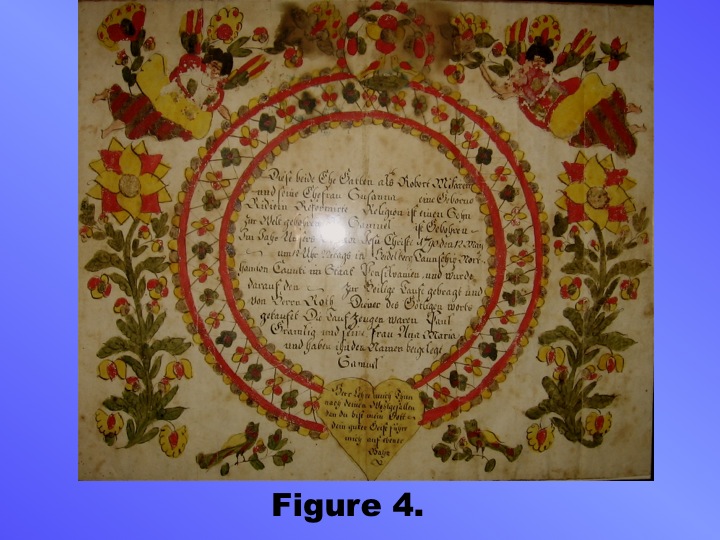 Our next taufschein example combines typical and atypical qualities in a revealing way. Initially it seems to return to the style of the first image discussed, since it is entirely by hand and done by an anonymous, though prolific, craftsman, who has come to be called the Flying Angel Artist (active c. 1780-1811) due to the frequency of that distinctive figure in his work (figure 4). After Friederich Krebs, this artist was probably the most prolific taufscheine producer, and his work is found in five Pennsylvania counties—again, a territory that extends far beyond the bounds of the face-to-face community that is the nostalgically imagined host to a pre-industrial rural folk past. In addition to the flying angels in the top corners, this example follows this artist's standard format with a large broken circle used to frame the main text with a small heart at the bottom bearing a devotional text in German (usually "This heart of mine shall be all yours, O dear Jesus"). Familiar, too, of this artist is that it announces the family's confessional commitment to the German Reformed church and baptism therein, but does not include the date of baptism.
In all the ways described above including its visual style and palette, this item is highly representative of the artist and the genre, but what sets it apart as exceptional is that it recorded the May 1790 birth of Samuel "McFaren," a decidedly non-German name, the son of Robert and his lawful wife Susanna, who had the maiden name Reed or Riedy, based on her being born a "Ridiein," as it appears on the document with the feminine suffix "-in." This classic example of a Pennsylvania German taufschein forcefully reminds us that in large parts of interior Pennsylvania, Maryland, Virginia, and even into the Carolinas, local cultural expression occurred in a multicultural setting with influential tones derived from central European traditions. There is no question that a Scots Irish name as the subject of a taufschein is unusual, but it is yet another example of the non-hegemonic nature of Anglo-American norms (whatever these might be) in Pennsylvania, especially as one examines evidence beyond the bounds of formal politics, law, and, of course, English-language texts. 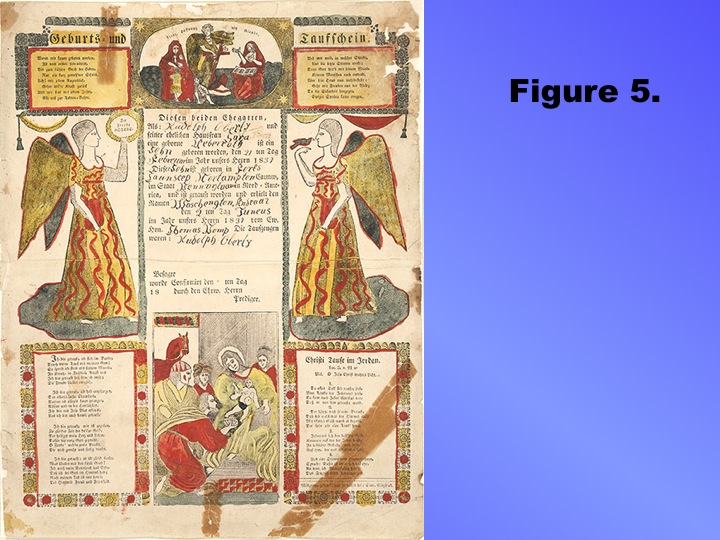 A final taufschein moves us well into the nineteenth century and demands that we acknowledge that the form had both a narrow grammar of standard expression as well as significant capacity to adapt to changing circumstances. This certificate for "Waschengton Andraas Oberly," born and baptized in 1837, immediately stands apart from the other birth and baptismal certificates examined so far in terms of its visual style (figure 5), and there is little question that this example is not among those that are most highly prized by collectors and museums that exhibit the visual arts. Some key parts of this example remain immediately familiar: it is a printed form, its bright colors and personal information is added by hand, its language is German, the printed text in fraktur letters, the handwritten text in script. Yet it still expresses a fundamentally Victorian Anglo-American tone with its vertical orientation and the flowers, hearts, and other iconic Pennsylvania German icons so familiar from earlier examples, mostly replaced by didactic religious scenes like the adoration of Jesus by the three shepherds at the bottom center and three female figures representing the virtues of love (or charity), hope, and faith at the top center.
Closer scrutiny, however, encourages us to see the newer visual elements on this form as enhancing, rather than departing from, a fundamentally Pennsylvania German ethno-religious expression, just as the birth child's name, Waschengton Andraas Oberly, announces him as distinctly American and German. These continuities with the older style begin with obvious elements like the use of the German language, fraktur letters, and the boldface printed title at the top of the form that announces this as a "Geburts-und Taufschein." The continuities with Pennsylvania German expression extend to more subtle elements as well like a familiar palette of bold red and yellow colors and even the placement of a bird on the finger of the large angel on the right hand side. While there is more devotional text here than on previous examples, it repeats the same three principal devotional texts about baptism that also appeared in the Kostenbader taufschein (figure 2), now with the addition of a scriptural account of Christ's baptism in the Jordan (Luke 3: 21-22) in the bottom right corner.
The printer of this form, Samuel Siegfried (1797-1869), may have directly copied the cofrontal angels on his piece, its largest visual symbols, from the Harrisburg printer Gustav S. Peters and also followed the general layout of the Peters example quite closely. Don Yoder has described the Peters taufschein as the "most widespread printed example from the first half of the nineteenth century. It turns up almost everywhere." What's particularly interesting, then, is to compare how Siegfried and Peters developed the genre in similar and divergent ways. The Peters version is both more strongly Pennsylvania German, with a pair of large birds in each bottom corner following the template of earlier vertical-oriented taufscheine printed by John (alternately Johann) Ritter (1779-1851) in Reading, and more explicitly American, with an eagle at the top center clasping a ribbon in its beak that announces "E Pluribus Unum." In place of such ethnic and nationalist assertions by Peters, Siegfried favored a more forcefully Christian expression. In addition to the biblical and devotional content described above, he adds the phrase "The Peace of God" within the wreath that the left hand angel holds at head height and includes a prompt to the hymn "O Jesu Christ wahres Licht" before the scriptural passage at the bottom right.
The more overt Christian iconographic, textual, and musical emphasis as well as the more strongly Victorian visual style over time is nicely exemplified by how the Ritter press in Reading, the seat of Berks County, Pennsylvania, modified the form between the 1820s and the early 1840s. A rather whimsical looking putto lying in the clouds and holding a horn and an envelope in each extended hand crowns all. The largest images on the document, winged female angels with a lyre in one hand and either a wreath or a bird in the other, are retained in the 1840s version but have been rotated from a profile view to directly face the reader and one arm of each now reaches skyward. Most tellingly, within the large central block of printed and hand lettered text two grouped smaller icons have substantially changed. In the later version a cluster of musical instruments (once in the middle register) has been moved to the bottom and in the higher space a striking open Bible radiates light with a dove flying above. The addition of the Bible led to the exclusion of an earlier agricultural icon (formerly in the bottom register) with a wheat sheaf, cornucopia, and leaves of grass. While the text of this 1840s version remains all in German and paired birds remain in the bottom corners, the explicit rural symbol is gone, and the Pennsylvania German visual tone has been muted by a decidedly more Victorian one.
Samuel Siegfried's printed taufschein for Waschengton Oberly from the late 1830s clearly was crafted in close dialogue with the Ritter and Peters examples even though only the large facing angels with lyres, a wreath, and a bird are immediately recognizable as remaining from the other printers' work. Above all, Siegfried advanced a more conventionally and explicitly Christian expression of the genre, yet, when we consider that the Reformed minister at Easton, Thomas Pomp, performed the baptism on the 1837 certificate, as he also did on three of the four primary examples discussed earlier that are reproduced in this essay, we are reminded that taufscheine announced a persistent form of ethno-religious expression with pictorial, textual, and personal resonances firmly embedded in past practices even as certain dimensions of the form changed to keep up to date with broadly "American" developments in the 1830s, especially the growing Christianization of U.S. public life in the early national period. While Siegfried was an active entrepreneur, often working with the Bath printer John Driesbach, he did so as someone deeply familiar with the roots of the genre as he demonstrated in the stunning hand drawn, hand colored, and fraktur-lettered taufschein that he made for the birth and baptism of his brother Daniel in 1810.
While the intricate details of individual taufscheine and the sophisticated interplay among printers, decorators, scriveners, family members, baptismal sponsors, and officiating ministers are all fascinating and important in their own right, there is a danger of being drawn too deeply into the explication of this specialized information that risks not only drowning in minutiae but also unwittingly reinscribing the inaccurate notion that such material was the esoteric and private possession of a peculiar people isolated from an Anglo-dominated America that demanded that Pennsylvania Germans leave behind distinctive cultural expression in order to become fully American. Yet as we have seen in the case of the Samuel McFaren taufschein (figure 4), a reverse form of acculturation, what the historian A. G. Roeber has identified as "transferred local osmosis," also occurred across a large region of Pennsylvania German prominence. Moreover, as the work of Samuel Siegfried suggested (figure 5), taufschein producers remained successful throughout the nineteenth century by combining traditional and innovative designs as well as pioneering new means of reproduction. Indeed, Currier and Ives, archetypal purveyors of commercial American culture in the industrial age, mass produced English and German-language taufscheine to reach a significant market in the nineteenth-century United States.
A critical interpretive challenge is to move from a close focus on specific examples to assess the larger patterns that taufscheine made and reflected in the society and culture of Revolutionary America. One way to think more categorically about these objects is to shift our attention from individual artifacts to consider the geographic range of one very active itinerant artist. His distinctive work is well known in part because it has been found from the Carolinas to Ontario, yet this craftsman remains known only by the style of his pen and the characteristic opening lines of many of his certificates that advise the child to Honor Father and Mother (Ehre Vater und Mutter), thus this anonymous artist is known as the Ehre Vater Artist (active 1782-1828). 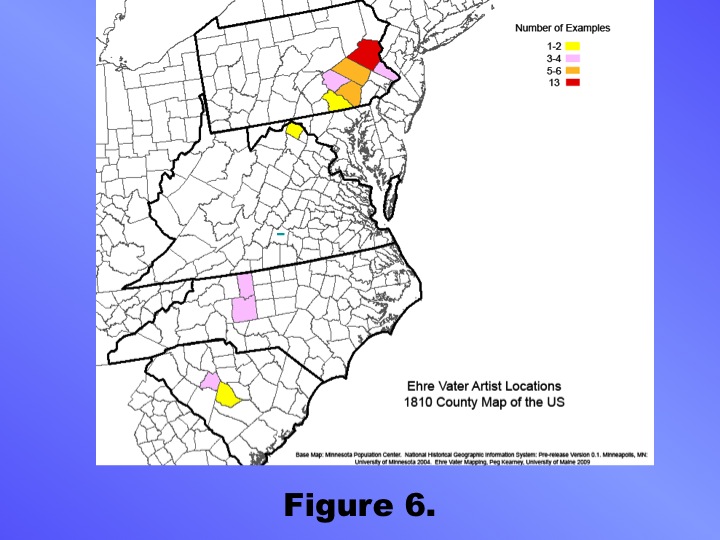 A spatial analysis of this artist's work suggests two important points about the geography of Pennsylvania Germans in Revolutionary America (figure 6). First, there is a familiar core region in southeastern Pennsylvania that arcs around Philadelphia. While that crescent shape is immediately recognizable as the major zone of Pennsylvania German settlement in British America, the Ehre Vater Artist's most intensive work occurred northwest of Philadelphia in Northampton County and Berks County (with the top counts of 14 and 7 examples, respectively) as opposed to iconic Pennsylvania Dutch Lancaster County to the west of Philadelphia. Indeed, if we group the three northerly Pennsylvania German counties (adding Bucks to the two named earlier), they have 24 examples, while Lancaster and its adjoining more southerly ones of Dauphin and York number 11. The second main point to be gleaned from this map comes by looking beyond state boundaries to recognize the limitations of the term "Pennsylvania" Germans. This single artist also did work in Virginia, North Carolina, and South Carolina, a total of 16 examples, and immigrants who settled around Lake Ontario carried some of his work to Canada.
While this map reflects the particular pathways and idiosyncrasies of an unusually peripatetic artist and so must be evaluated with caution, it suggests the gains to be reaped by assessing Pennsylvania German material culture beyond a single precious artifact and its embedded local community both of which can be misleading. Perhaps most importantly, attention to itinerancy reminds us that taufscheine can profitably be considered as "objects in motion" that call on their viewers to make meanings from their relationship with a mixed textual and symbolic form and that invoke reflection about how materiality and identity give shape to one another. A large chronological distance separates us today from the original performative context of these objects, their producers, and their initial viewers, yet their material persistence and vastly enlarged audience given new technologies of distribution and presentation like the Free Library of Philadelphia's Digital Fraktur Collection demands that we reconsider how people and objects interact both in the broad Revolutionary Era and today. The tool kit of practices that taufscheine made (and still makes) available offers us a significant route to assess how Pennsylvania Germans made their experience "real" and purposeful in a particular time and place. This concern with practice and performance attempts to rehabilitate the importance of agency and "the social" in our assessment of culture by navigating a course between extreme assertions of an essentialist essence, on the one hand, and an all-controlling discursive power, on the other, both of which deny the capacity for individuality that taufscheine so effectively recorded and preserved.
Future scholarship needs to assess a fuller range of Pennsylvania German culture at the level of entire genres, and, even more importantly, how different forms of expression shaped one another both within this cultural group and in interaction with other groups as obviously occurs in lived experience. How did published texts like almanacs, manuscript writing of all kinds, musical forms like hymns, highly recognizable foodways, vernacular building traditions and landscape use, medical practices from apothecaries to "powwowing," and the handmade and mass produced visual and textual terrain of fraktur combine to inform, maintain, and transform Pennsylvania German identity in early America?
An important body of scholarship in folklife studies and ethnographic cultural anthropology already exists, but a great deal remains to be done to explain this dynamic tradition and its significance. This new work should aspire to more than descriptive narrative and the recovery of little known examples and forms. The tremendous gains of a generation of social history scholarship have made us aware of a far more diverse and varied early American reality than we once recognized. The promise of cultural history lies not just in its multidisciplinary examination of wide-ranging evidence but also in its deep awareness of the local variability, fluidity, and transcendent potential of cultural expression. In place of the sometimes static structures and narrow boundaries of some social history scholarship, cultural historians should pursue how the web of meanings that people crafted to understand themselves and their society often crossed rigid lines of exclusion in ways that may be a unique province of the human imagination.
This kind of engaged interpretive practice is especially promising for those who study German-speaking people in early America, because its prioritization of the importance of culture as an integrative force makes the interstices of group interaction and boundary maintenance of pressing concern. While ethnicity has long been weighed down by connotations of marginality, subculture, and provincial isolation, this brief foray into the meaning of taufscheine finds just the opposite. These wondrously evocative forms were expansive, integrated, and shaped a widely shared common culture in the Revolutionary Mid-Atlantic with a much larger hinterland to the south, north, and west than is typically acknowledged. In his recent tour de force about the enormous contribution of craftsmen, their goods, and their consumers for the "village Enlightenment" of "cosmopolitan communities" in New England between the American Revolution and the Industrial Revolution, the gifted cultural historian David Jaffee has blazed a trail that scholars of Pennsylvania Germans in this same era should pursue and enlarge. New England cannot stand for all America, and we cannot allow the riches of non-Anglo early America to continue to be treated as peculiar. Non-English cultural traditions were crucial from the very initiation of the creole colonial project, and, of course, creolization was not created by colonization, although the colonial context intensified and combined more varied cultural elements as a result of voluntary and coerced transatlantic and continental migrations that both dramatically intensified in the eighteenth century. Paying close attention to cultural persistence, transformation, and interaction in the early modern era is ever more important as we seek a fuller understanding of our own globalized and multicultural present.
Although the English word ethnicity is of twentieth-century coinage, the term's Greek origins emphasized national distinctiveness, as did its use in fourteenth-century Scotland. Ethnic associations are too deeply rooted in human experience to be properly studied as only recent phenomena; see Anthony D. Smith, The Ethnic Origins of Nations (New York: Basil Blackwell, 1986) and John A. Armstrong, Nations Before Nationalism (Chapel Hill: University of North Carolina Press, 1982). For a sophisticated study of colonial ethnicity, although it avoids use of the concept, see Ned C. Landsman, Scotland and Its First American Colony, 1683-1765 (Princeton: Princeton University Press, 1985). Kathleen Neils Conzen, David A. Gerber, Ewa Morawska, George E. Pozzetta, and Rudolph J. Vecoli, "The Invention of Ethnicity: A Perspective from the U.S.A," Journal of American Ethnic History, 12 (1992-93): 3-41, provides a useful conceptual framework. The essential historiographic starting point for German-speaking people in early British America is A. G. Roeber, "The Origins of Whatever is Not English among Us": The Dutch-speaking and German-speaking Peoples of Colonial British America" in Bernard Bailyn and Philip D. Morgan, eds., Strangers Within the Realm: Cultural Margins of the First British Empire (Chapel Hill: University of North Carolina Press, 1991), 220-83.
Culture became a widespread interpretive and thematic priority in the historical discipline by the late 1980s that has been described as a scholarly response to "shifting relations of advanced capitalism," especially a move "toward neoliberal emphasis on deregulated markets combined in the context of the dramatically expanded power of media." An early effort to mark the contours of this diffuse movement was Lynn A. Hunt, ed., The New Cultural History (Berkeley: University of California Press, 1989). Influential recent calls to redirect cultural history include Geoff Eley, A Crooked Line: From Cultural History to the History of Society (Ann Arbor: University of Michigan Press, 2005) and William H. Sewall, Jr., Logics of History: Social Theory and Social Transformation (Chicago: University of Chicago Press, 2005). Also see the four-scholar forum about Eley's A Crooked Line in The American Historical Review 113 (April 2008): 391-437. A recent assessment calling for greater attention to eighteenth century meanings of culture as a concept related to agriculture and governance is Michael Meranze, "Culture and Governance: Reflections on the Cultural History of Eighteenth Century British America," William and Mary Quarterly 65 (October 2008): 713-744; the quotation at the start of this note is from Meranze summarizing Sewall, 742.
For a catalogue of more than 1,200 variants of printed birth and baptismal certificates, organized by printers' locations, and including representative reproductions, see Klaus Stopp, ed., The Printed Birth and Baptismal Certificates of the German Americans (East Berlin, Pennsylvania: Russell D. Earnest Associates, 6 vols., 1997), hereafter cited as Printed BBCs. For genealogical content and an emphasis on the biographies of artists and scriveners who worked by hand, see Russell D. Earnest and Connie P. Earnest, Papers for Birth Dayes: Guide to the Fraktur Artists and Scriveners (East Berlin, Pennsylvania: Russell D. Earnest Associates, 2 vols., 2nd ed., 1999; orig. 1989). These remarkable multi-volume undertakings aspire to be comprehensive and provide an essential foundation for this essay, as does the most important monograph on the subject by Donald A. Shelley, Fraktur-Writings or Illuminated Manuscripts of the Pennsylvania Germans (Allentown: Pennsylvania German Folklore Society, vol. 23, 1961). I use the standard title for Shelley here, but the copy that I have examined uses the title of his 1953 dissertation The Pennsylvania German Style of Illumination.
Statistic cited in Scott T. Swank, ed., Arts of the Pennsylvania Germans (New York: Winterthur and Norton, 1983), viii. In addition to Swank, the most important starting points for Pennsylvania German cultural expression are Don Yoder's learned and lavishly illustrated The Pennsylvania German Broadside: A History and Guide (University Park: Pennsylvania State University Press, 2005), Cynthia G. Falk, Architecture and Artifacts of the Pennsylvania Germans (University Park: Pennsylvania State University Press, 2008), and Nancy Van Dolsen, ed., "Architecture and Landscape of the Pennsylvania Germans, 1720-1920," guidebook for the Vernacular Architecture Forum's annual conference in 2004.
A note on terminology: fraktur refers to a specific calligraphic lettering style based on a popular typeface in German-speaking Europe that began in the mid-sixteenth century. The term is also applied more broadly to include a huge range of Pennsylvania German style decorated manuscripts, which need not be written in German nor use broken-letter fraktur, to still be considered fraktur. Taufschein (and its plural form taufscheine) refer to the most widespread example of North American fraktur work, the Pennsylvania German birth and baptismal certificate, which is the standard shortened form of geburts-und taufschein.
The Fraktur Digital Collection at the Free Library of Philadelphia (hereafter cited as FDC) is found at http://libwww.freelibrary.org/fraktur/index.cfm (accessed March 22, 2011). When discussing specific items from this collection below, I will cite them according to their "shelfmark," the most prominent of several item-level identifications on the website (which typically begins with FLP followed by a number). I am deeply appreciative of the superb work done by Lisa Minardi in creating this site as well as her generosity in guiding me through the riches of the Winterthur library and museum's rich holdings of Pennsylvania German material. The FDC is a fitting twenty-first century update to the impressive and still valuable illustrated catalogue by Frederick S. Weiser and Howell J. Heaney, Pennsylvania German Fraktur of the Free Library of Philadelphia (Breinigsville: Pennsylvania German Society and Free Library of Philadelphia, 2 vols., 1976).
The principal sources for the count of Northampton County fraktur artists are Earnest and Earnest, Papers for Birth Dayes, the FDC, and Stopp, Printed BBCs. In addition to these, I have examined Northampton County fraktur examples at the Northampton County Historical and Genealogical Society, Easton Area Public Library, Library Company of Philadelphia, Free Library of Philadelphia, Philadelphia Museum of Art, and the Winterthur Library and Museum. Liam Riordan, Many Identities, One Nation: The Revolution and Its Legacy in the Mid-Atlantic (Philadelphia: University of Pennsylvania Press, 2007) compares and contrasts the trajectory of Pennsylvania Germans in Easton with African Americans in New Castle, Delaware, and Quakers in Burlington, New Jersey, among other groups, from 1770 to 1830.
On church Germans as about 90 percent of German-speaking people in British North America, the close relationships of German Reformed and Lutheran congregants and the ubiquity of the union church as an institution, see Charles H. Glatfelter, Pastors and People: German Lutheran and Reformed Churches in the Pennsylvania Field, 1717-1793 (Breinigsville: Pennsylvania German Society, 2 vols. 1980-81).
For more information and images, see the detailed study of 569 churches in four states by Donald H. Herr, Pewter in Pennsylvania German Churches (Birdsboro: Pennsylvania German Society Proceedings, Volume 24, 1995), 180, 35-37, and 137.
For the important identification of the Easton Bible Artist as Spangenberg, see Monroe H. Fabian, "The Easton Bible Artist Identified," Pennsylvania Folklife 22 (1972-73): 2-14. Images of his work are reproduced there, as well as in Riordan, Many Identities, 130f (figures 22 and 23).
Frederick S. Weiser, "Piety and Protocol in Folk Art: Pennsylvania German Fraktur Birth and Baptismal Certificates," Winterthur Portfolio 8 (1973): 8. The Mainz-based collector Klaus Stopp noted some parallels in taufpatenbrief and an Alsatian visual repertoire, but emphasized that there were no exact European equivalents, Stopp, Printed BBCs, I, 15-18. Weiser and Heaney noted parallels along the Upper Rhine in baptismal sponsors' gift of a coin (tauftaler) and letter (gottelbrief) in Pennsylvania German Fraktur, I, xxi-xxii. Earnest and Earnest find the form "decidedly American" in Papers for Birth Dayes, I, 14. Yet Don Yoder offers an important corrective to extreme claims of autochthonous New World origins that stresses the growth of calligraphy among non-elites in early modern central European villages as a critical precursor for the late-eighteenth century explosion of taufscheine in Greater Pennsylvania. See his "The European Background of Pennsylvania's Fraktur Art" in Bucks County Fraktur, Cory M. Amsler, ed. (Kutztown: Pennsylvania German Society, volume 33, 1999), 14-41. That a majority of taufschein artists were probably immigrants from central Europe further reinforces the transnational origins of this form.
Yoder, "European Background," 32.
I do not mean to insist upon a sharp secular-sacred dichotomy, for there is no question that popular religiosity deeply informed Pennsylvania German culture in this era. The Lutheran minister and scholar Frederick Weiser has stressed the "secular motivation of the love of decoration" in taufschein iconography and also notes their importance for recording birth data in Weiser, "Piety and Protocol," 43 (quote), 32, 35. Even in an essay that stresses the spiritual core of fraktur work, Don Yoder notes that taufscheine lacked the "Pietist pessimism" so prevalent in writing exercises (vorschriften), see his "The Fraktur Texts and Pennsylvania-German Spirituality" in Amsler, Bucks County, 50, 58.
On the parrot and Otto's influence, see Shelley, Fraktur-Writings, 84, 89.
For detailed biographical information on Krebs as well as a list of all known examples of his work, see Earnest and Earnest, Papers, I, 460-467.
The most detailed assessment of Krebs is Frederick S. Weiser, "Ach wie ist die Welt so Toll! The mad, lovable world of Friedrich Krebs," Der Reggeboge (The Rainbow) 22 (1988): 48-88, for details about his estate and accounts, see 60-62. The important evidence about the scale of Krebs' production and purchases from the Reading press was first reported by Alfred L. Shoemaker, "Notes on Frederick Krebs, The Noted Fractur Artist," The Pennsylvania Dutchman 3 (November 1, 1951), 3. For more information about Shoemaker as a pioneer of Pennsylvania German folklife studies, see "Alfred Shoemaker and the Discovery of American Folklife," chapter six in Simon J. Bronner, Following Tradition: Folklore in the Discourse of American Culture (Logan: Utah State University Press, 1998), 266-312.
For an exploration of "authentic" vs. "false" folk expression that rejects that distinction and calls for greater theoretical attention to commercial and even self-consciously "folk" production, see Regina Bendix, "Folklorism: The Challenge of a Concept," International Folklore Review 6 (1988): 5-15.
The great popularity of and variations on the three-heart form that was printed in many different towns and cities can be traced across a wide region in Stopp, Printed BBCs.
An identical copy of the Kostenbader form printed by John (alternately Johann) Ritter in Reading appears in the FDC, FLP #262. I have followed the translation there that is more literal than the one reprinted in Garvan from a Victorian 1855 translation. For this later English version, see Beatrice B. Garvan, The Pennsylvania German Collection (Philadelphia: Philadelphia Museum of Art, 1982), 339, #9 and 338, #1. The Kostenbader taufschein itself is also reproduced here on 298, #9.
Yoder, Pennsylvania German Broadside, 332 n7, 232-233. For a detailed assessment of the increasingly standardized use of specific devotional passages on taufscheine, see Frederick S. Weiser, "The Concept of Baptism Among Colonial Pennsylvania Lutheran and Reformed Church People," Lutheran Historical Conference 4 (1970): 1-45.
I have not been able to find a plausible connection between the lay people named on the taufschein and any individual listed in the records of the Easton German Reformed congregation, which included the neighboring rural townships of Plainfield, Mt. Bethel, Dryland, Forks, and Williams in Pennsylvania as well as Greenwich, New Jersey, as reprinted in Henry Martyn Kieffer, Some of the First Settlers of "The Forks of the Delaware" and Their Descendents, Being a Translation From the German of the Records Books of the First Reformed Church of Easton, Penna from 1760 to 1852 (Westminster, MD: Family Line Publications, reprint 1990; orig., 1902).
Earnest and Earnest, Papers, I, 203.
Deubler's significant role inserting personal information with some form of portable press was first established by Alfred Shoemaker in the Pennsylvania Dutchman 4 (November 1952), 14.
This example by Otto can be viewed at the FDC, FLP #4.
Earnest and Earnest, Papers, II, 594 (quote), for biographical information and a list Otto's known work, see II, 594-600; for Deubler, I, 184; and for Dulheuer, I, 201-04. I follow the Earnests in seeing the Romich taufschein as made by these three men, but Yoder interprets its freehand design and coloring to lack Otto's skill, and thus attributes a larger artistic role to Dulheuer, see Yoder, Pennsylvania German Broadsides, 233, 235.
For information about the Flying Angel Artist (sometimes identified as the Blowsy Angel Artist in older publications), see Earnest and Earnest, Papers, I, 283-86. The McFeran taufschein is not listed by the Earnests. The DFC database includes 8 examples by this artist as well as a very interesting woodblock that matches this artist's style closely, although no imprints from this particular woodblock are extant. The translation of the devotional text follows that by the DFC.
The Northampton County Historical and Genealogical Society (NCHGS) in Easton, Pennsylvania, owns this taufschein. I have relied on the English translation from the German by Lorrie Brownmiller that is attached to the back of the framed object. I greatly appreciate the generous assistance of curator Andria Zaia and former executive director Colleen Lavdar in helping me examine the rich material at the NCHGS in summer 2009.
On Germanic forms intertwining with and sometimes overshadowing Anglo ones in Northampton County, Pennsylvania, see Riordan, Many Identities, 31-32, 106-116, 268-72.
The Oberly taufschein is reproduced with a complete German transcription and English translation in the DFC, FLP #147.
Yoder reprints the Peters example in color on the front cover of his book, Space limitations prevent its being reproduced here, but several related examples can easily be located in the DFC. Peters and Siegfried are both known to have also printed English-language versions of their religious certificates, see Yoder, Pennsylvania German Broadside, 235-36, 246-47, 183f (color image). Note that Yoder identifies the Northampton County printer, artist, and scrivener by the name of his brother Solomon (rather than Samuel) Siegfried. For biographical information, see Earnest and Earnest, Papers, II, 704.
This widespread form may have been pioneered by the important Ritter press, which also printed forms for Friederich Krebs as discussed earlier. However, the attribution of this style to Ritter in 1802-04 by Garvan seems to be at least twenty years too early. The chief addition by Peters to the Ritter form was the replacement of a putto at the top center with the American eagle. For examples of the Ritter version, see Garvan, Pennsylvania German Collection, figs. 21-23, 302-03, then as copied by the Harrisburg printer John S. Wiestling in the 1820s with the addition of an American eagle and shield in a lower central register, fig. 27, 304, as well as versions by the Carlisle shop of Moser and Peters, fig. 34, 306, and the Allentown one of Blumer and Leisenring, fig. 42, 308, and, finally, a completely hand drawn version clearly modeled on the printed Wiestling example, fig. 30, 305. The DFC website includes 5 Ritter examples and 11 from the press of Peters, first in Carlisle in partnership with Moser in the mid-1820s, and then with Moser and on his own at Harrisburg into the 1840s. This does not exhaust the known variants of this ubiquitous form, which can be traced further in Stopp, Printed BBCs, but suffices to indicate its geographic breadth, the interaction among numerous printers using this form, and the rich combination of hand and mechanical production all of which fundamentally shaped the taufschein genre.
This analysis compares four nearly identical examples from Ritter's press in the DFC that date to the 1820s (FLP #144, FLP #1006, FLP #1012, FLP #1013) with one dated c. 1841-43 (FLP #141). The best scholarship on this county seat, which estimates that about 85 percent of its inhabitants were of German descent in the early 1770s, is by Laura L. Becker, "The American Revolution as a Community Experience: A Case Study of Reading, Pennsylvania" (University of Pennsylvania, unpublished Ph.D. dissertation, 1978) and "Diversity and its Significance in an Eighteenth-Century Pennsylvania Town" in Michael Zuckerman, ed., Friends and Neighbors: Group Life in America's First Plural Society (Philadelphia: Temple University Press, 1982), 196-221.
For my discussion of similar themes of Americanization and Pennsylvania German persistence in the 1827 German Reformed confirmation certificate of Jesse Oberly, probably a relative of Waschengton Oberly, see Riordan, Many Identities, 130f, fig. 24, 164-66. On the Christianization of the early national U.S., see Jon Butler, Awash in a Sea of Faith: Christianizing the American People (Cambridge: Harvard University Press, 1990), especially 257-88.
This signed and dated Siegfried taufschein is well presented on the DFC website, FLP #49.
For an insightful analysis of ethnicization and Americanization as intertwined processes in this period, see Steven M. Nolt, Foreigners in Their Own Land: Pennsylvania Germans in the Early Republic (University Park: Pennsylvania State University Press, 2002).
A. G. Roeber, "Pennsylvania Germans and German Speakers" in van Dolsen, ed., "Architecture and Landscape of the Pennsylvania Germans," 2.
I was made aware of the Currier and Ives' taufscheine, as well as the deeply Victorian quality of many Pennsylvania German prints, by Don Yoder's important broadside study. For the "Pennsylvania Dutch" firm of Crider & Brother of York, Pennsylvania, that pioneered the combination of photography and printed marriage certificates on a national scale in the late-nineteenth century, see Yoder, Pennsylvania German Broadsides, 261, 228. For an undated German-language Currier and Ives taufschein, see http://www.printsoldandrare.com/currierandives/020ci.jpg (accessed April 5, 2011).
For the prominence of this phrase in his work, see the DFC, FLP #90 and FLP #1005. Biographical details and a list of 50 known examples by this artist can be found in Earnest and Earnest, Papers, I, 225-28, which is the key source for the map in figure 6.
Since county lines change over time, it is important to note that the 1810 base map used here predates the creation of Lehigh County from southernmost Northampton County in 1812 as well as the creation of Lebanon County from Dauphin and Lancaster in 1813, and Lebanon County's 1821 expansion at the expense of Dauphin. Lancaster County was originally created in 1729 and Berks and Northampton followed in 1752. These boundary changes are easily examined at http://www.familyhistory101.com/maps/pa-maps.html (accessed March 22, 2011). For an emphasis on the distinctiveness of Pennsylvania German culture in Central Pennsylvania (west of the Susquehanna River) with its close ties to Baltimore and Appalachia, see Don Yoder, "The Discovery of Central Pennsylvania" in Discovering American Folklife: Studies in Ethnic, Religious, and Regional Culture (Ann Arbor: UMI Research Press, 1990), 185-197.
On the Ehre Vater Artist's work around Wachovia, North Carolina, see John Bivins, Jr., "Fraktur in the South: An Itinerant Artist," Journal of Early Southern Decorative Arts 1: 2 (November 1975): 1-23 as well as Klaus Wust, Virginia Fraktur: Penmanship as Folk Art (Edinburg, VA: Shenandoah History, 1972). On Pennsylvania German folk art in Canada, much of it produced by members of German sect groups, see Michael S. Bird, Ontario Fraktur: A Pennsylvania-German Folk Tradition in Early Canada (Toronto: M. F. Feheley Publishers, 1977) and Susan M. Burke and Matthew H. Hill, eds., From Pennsylvania to Waterloo: Pennsylvania-German Folk Culture in Transition (Kitchener, Ont.: Joseph Schneider Haus, 1991).
The argument and language in this paragraph is indebted to two thoughtful essays. On the importance of assessing objects in motion as part of an etiquette and aesthetics of everyday life, see Bernard L. Herman, "On Being German in British America: Gravestones and the Inscription of Identity," an unpublished essay kindly shared by the author. For a compelling call for cultural history to embrace a semantic concern with performance as an accommodation between poststructuralism and social history, see Gabrielle M. Spiegel, "Introduction" in Practicing History: New Directions in Historical Writing after the Linguistic Turn (New York and London: Routledge, 2005), 1-32.
David Jaffee, A New Nation of Goods: The Material Culture of Early America (Philadelphia: University of Pennsylvania Press, 2010).